Morse code (CW)
Text sent as short and long beeps (dits and dahs) by switching a single tone on and off. It's the oldest digital mode on the air, and still one of the most popular.
Morse code sounds like a single clear beep switching on and off in short and long pieces, grouped into letters and words with brief silences between them.
What does it sound like?
A clean, steady beep turning on and off in a rhythm, like a very fast telegraph.
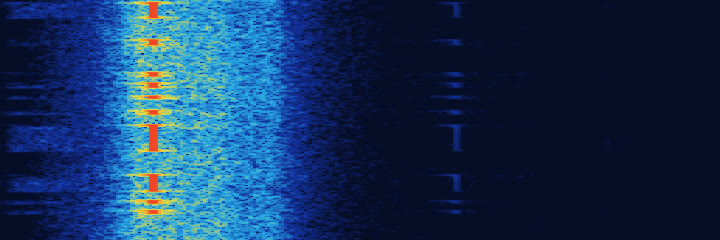
4.5-second example. Recording: Freesound recording freesound-straightkey-cw-ke4dyx-de-k0gdd-182128 (CC0).
Who uses it?
Amateur radio operators worldwide, beacons, some navigation aids and a few utility stations.
Where and when can I hear it?
All over the ham bands, most often near the bottom of each band (for example, 7.000-7.060 and 14.000-14.070 MHz). The ARRL's station W1AW sends Morse practice and bulletins on a published schedule.
What do the decoded parts mean?
- Text: The letters and numbers being sent. Hams use many abbreviations: CQ means 'calling anyone', DE means 'from', 73 means 'best regards', and RST numbers such as 599 are signal reports.
Easily confused with
- Radioteletype (RTTY): RTTY uses two tones and never goes silent between letters
- Time signal station: a time station ticks exactly once a second
How to recognize it
Listen for one steady pitch that is either on or off. There is no second note, no warble and no hiss inside the tone itself. The short sounds (dits) and long sounds (dahs) are in a fixed ratio of about one to three, and the gaps tell you where letters and words end: a short gap inside a letter, a longer one between letters, and a longer one still between words.
The pitch you hear is set by your own receiver, not by the sender. Most operators tune so the tone sits somewhere around 500 to 800 Hz, which is why two people listening to the same station may hear it at different pitches.
Easily confused with:
- Radio beacons and navigation aids: also Morse, but they repeat the same short identifier (often two or three letters) over and over.
- RTTY: two tones that alternate with no silences, rather than one tone that stops and starts.
- An unmodulated carrier: a single tone that never switches off.
Where and when to hear it
On the ham bands, Morse gathers at the low end of each band. Evenings on 40 meters (7.000-7.060 MHz) and daytime on 20 meters (14.000-14.070 MHz) are reliable places to start. Contest weekends fill these segments wall to wall.
For a known, readable signal, the ARRL's station W1AW in Connecticut sends code practice and bulletins on a published schedule, on frequencies including 3.5815, 7.0475 and 14.0475 MHz. Slow practice runs from 5 to 15 words per minute, fast practice from 35 down to 10, and bulletins go out at 18 words per minute. Because the text of many practice sessions is published, it is a good way to check your own copying.
The Northern California DX Foundation and IARU run a worldwide chain of beacons on 14.100, 18.110, 21.150, 24.930 and 28.200 MHz. Each beacon sends its call sign in Morse in a fixed 10-second slot, so a whole cycle takes three minutes, and hearing which ones come through tells you which parts of the world a band is reaching.
A little history
Samuel Morse and Alfred Vail developed their telegraph code in the 1830s and 1840s; the famous message "What hath God wrought" crossed the line from Washington to Baltimore in May 1844. The version used on the radio today is the International Morse Code, which differs from the original American code in several letters.
Radio took Morse wireless at the turn of the twentieth century, and for most of that century it carried shipping, aviation and military traffic. Ships formally stopped relying on it when the Global Maritime Distress and Safety System became mandatory on February 1, 1999. In the United States, the Federal Communications Commission dropped Morse testing for all amateur licenses in February 2007, yet it remains one of the most popular modes on the ham bands, because it gets through with simple equipment and weak signals.
Common questions
Is it legal to listen to Morse code on the radio?
Yes. Amateur and beacon Morse is sent in the open, and anyone may receive it. Listening needs no license; only transmitting does.
Why do Morse signals sound like different pitches?
Morse is sent as a plain carrier switched on and off. Your receiver turns that carrier into an audible tone, and the pitch depends on exactly how you tune. Move the dial slightly and the note rises or falls.
How fast is Morse code sent?
Speed is counted in words per minute, using a standard word ("PARIS") as the yardstick. Beginners start around 5 to 15 words per minute; everyday ham conversations run about 18 to 25; experts and contesters often go past 35.
Can I decode Morse code on a computer?
Yes. Free desktop programs such as fldigi can turn clean Morse into text, and many operators learn to copy it by ear. Machines struggle more than trained people with fading, interference and uneven hand-sent timing.