FT8
A weak-signal digital mode where stations exchange short, standard messages in 15-second turns. It can be copied even when the signal is too weak to hear.
FT8 sounds like a cluster of soft, quiet musical warbles side by side that all start together, run for about 13 seconds, and stop, repeating every 15 seconds.
What does it sound like?
Many soft, quiet musical warbles side by side, starting and stopping together every 15 seconds.
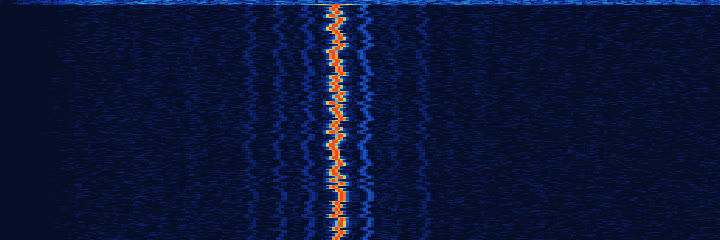
12-second example. Recorded off the air on the developer's own receiver.
Who uses it?
Amateur radio operators; it is the busiest digital mode on the ham bands.
Where and when can I hear it?
For example 7.074, 14.074 and 28.074 MHz. Transmissions start exactly at :00, :15, :30 and :45 seconds past each minute.
What do the decoded parts mean?
- CQ: A general call: 'anyone want to talk?'
- Call signs: Who is calling whom.
- Grid square: A four-character location code (for example CN85) marking a region about 100 by 70 miles.
- Signal report: A number such as -12, in decibels: how strongly one station hears the other.
- RR73 / 73: 'Received, best regards': the contact is complete.
Easily confused with
- FT4: FT4 turns every 7.5 s and is wider
- JS8Call: JS8Call sounds similar but carries free-text chat
- WSPR (propagation beacons): WSPR is far narrower and lasts 2 minutes
How to recognize it
The timing is the giveaway. Every signal in an FT8 segment begins within a second or so of :00, :15, :30 or :45 past the minute, lasts about 12.6 seconds, and then the whole band goes quiet while stations decode and decide what to send next. On a waterfall display, you see neat rows of short stripes, all lined up in time like bricks.
Each individual signal is only about 50 Hz wide. It steps among eight tones spaced 6.25 Hz apart, changing tone about six times a second, which gives it a gentle, burbling, almost melodic sound. Many signals are too weak to hear at all: FT8 was designed to be copied well below the noise.
Easily confused with:
- FT4: the same idea, but turns change every 7.5 seconds and each signal is wider and busier.
- JS8Call: sounds almost identical, but lives on its own frequencies (such as 7.078 and 14.078 MHz) and carries free-form chat.
- WSPR: a single very slow tone lasting almost two minutes, not 15-second bursts.
Where and when to hear it
FT8 has standard spots on nearly every ham band. Common dial frequencies (upper sideband) include 3.573, 7.074, 10.136, 14.074, 18.100, 21.074, 24.915, 28.074 and 50.313 MHz. The signals sit in the first 3 kHz above the dial frequency.
There is almost always activity somewhere: 20 meters (14.074 MHz) during the day, 40 and 80 meters at night, and 10 and 6 meters when those bands open. Because thousands of stations report what they receive to public maps such as PSK Reporter, FT8 has also become a quick way to see which bands are open right now.
A little history
FT8 was introduced in July 2017 in version 1.8 of the free program WSJT-X, written by Joe Taylor (K1JT, a Nobel Prize-winning astrophysicist) and Steve Franke (K9AN). It built on earlier weak-signal modes such as JT65 and JT9, but its 15-second turns made contacts four times faster than the one-minute modes. It spread with unusual speed and within a couple of years accounted for a large share of all activity on the HF ham bands.
Each FT8 transmission carries exactly 77 bits of information, protected by strong error correction and a checksum, so a message either comes through intact or not at all.
Common questions
Is it legal to listen to FT8?
Yes. FT8 is an open amateur radio mode with a published specification; anyone may receive and decode it. Only transmitting requires an amateur license.
Why can't I hear FT8 even when there are signals?
FT8 can be decoded at about 20 dB below the noise in a normal 2.5 kHz receiver bandwidth. Many of the stations your computer decodes are far too weak for your ears to pick out.
Why does my FT8 decoding fail?
The most common cause is the computer clock. Transmissions and decoding are locked to 15-second periods, so the clock needs to be accurate to within about a second. Setting it from an internet time source usually fixes it.
How do I decode FT8?
The free, open-source program WSJT-X, which introduced the mode, is the reference decoder. It needs audio from a receiver tuned to one of the standard frequencies in upper sideband.