JS8Call
A keyboard chat and messaging mode built on FT8's technology, for slow, robust conversations.
JS8Call sounds like FT8: soft, quiet warbling tones in timed turns, usually starting and stopping together every 15 seconds, with longer messages running over several turns.
What does it sound like?
Like FT8: soft warbling tones in timed turns.
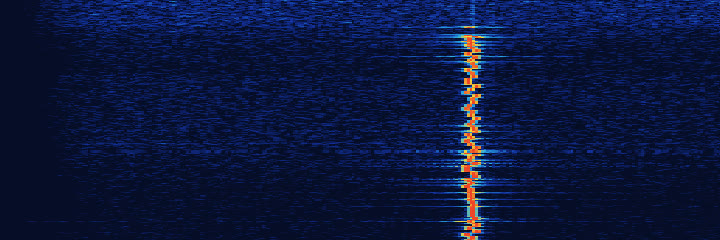
12-second example. Recorded off the air on the developer's own receiver.
Who uses it?
Amateur radio operators, including emergency-communications groups.
Where and when can I hear it?
For example 7.078 and 14.078 MHz.
What do the decoded parts mean?
- Messages: Free text, 'heartbeat' signals that say 'I'm on the air', and relayed messages between stations.
Easily confused with
- FT8: FT8 is structured short exchanges on the same clock
How to recognize it
JS8Call borrows FT8's signal design: eight gently stepped tones in a narrow slot about 50 Hz wide at normal speed. So the sound is the same soft, burbling warble. What differs is the behavior. Messages are typed text, so a single message can spread over several consecutive turns, and the band carries periodic "heartbeat" transmissions from stations simply announcing they are on the air.
The program offers several speeds. Normal uses 15-second turns like FT8; faster settings use shorter turns and wider signals, and a slow setting uses longer turns for weaker paths.
Easily confused with:
- FT8: almost the same sound, but on its own frequencies (7.074, 14.074 MHz) and with exchanges that finish in a few turns.
- FT4: shorter 7.5-second turns and a wider, busier sound.
- Olivia: a longer, continuous multi-tone warble without timed turns.
Where and when to hear it
JS8Call activity gathers just above the FT8 spots: common dial frequencies include 3.578, 7.078, 10.130, 14.078, 21.078 and 28.078 MHz (upper sideband). It is quieter than FT8, so it can take a while to catch activity, especially outside evenings and weekends.
Emergency-communications and preparedness groups use it for nets and for relaying messages when the internet or phone system is not available, since a message can hop from station to station until it reaches its destination.
Watching the program's activity list is often more revealing than listening. You will see stations sending heartbeats, replying to queries about signal strength, and leaving messages addressed to a group such as @ALLCALL. Like FT8, every station must keep an accurate clock, because turns begin on fixed boundaries of the minute.
A little history
Jordan Sherer, KN4CRD, started the project in 2017 as "FT8Call," an experiment to turn FT8's robust but rigid exchanges into free-form keyboard conversation. It was renamed JS8Call in 2018. He added store-and-forward messaging, relays and group calls, making it a weak-signal messaging system rather than just a contact-logging mode.
After several years with few releases, development picked up again in 2025, with version 2.3 and then a community-led effort that continues the program today.
Its design choice is a deliberate trade: FT8 gives up free-form text to be as fast and sensitive as possible, while JS8Call keeps most of that sensitivity but spends extra turns so people can say whatever they want.
Common questions
Is it legal to listen to JS8Call?
Yes. It is an open amateur mode, and anyone may receive it. Transmitting requires an amateur license.
How is JS8Call different from FT8?
The radio signal is almost the same, but FT8 sends short, structured messages for quick contacts, while JS8Call carries typed conversation, relayed messages and heartbeats.
Why do JS8Call messages take so long?
Each turn carries only a few characters. A longer message is split across several turns of 15 seconds each at normal speed, trading speed for reliability on weak signals.
How do I decode JS8Call?
Use the free JS8Call program itself, with audio from a receiver tuned to one of the JS8 frequencies. It also needs an accurate computer clock.