NAVTEX (maritime safety text)
An international system that broadcasts navigation warnings, weather forecasts and safety messages to ships as text.
NAVTEX sounds like a fast, choppy two-tone chatter, quicker and more clipped than ham RTTY, running continuously for a few minutes while each coast station takes its turn.
What does it sound like?
A rhythmic, chirpy two-tone chatter at a steady pace.
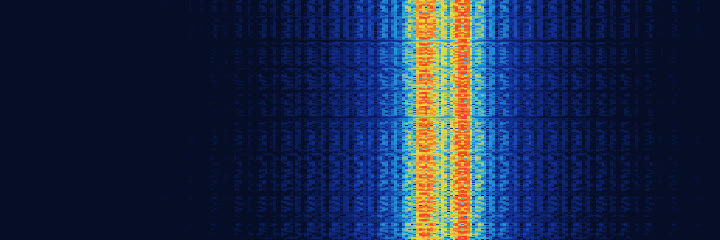
4.5-second example. A clean example made by our own signal generator; signals on the air usually sound noisier.
Who uses it?
Coast stations run by national maritime and coast guard authorities, received by ships at sea.
Where and when can I hear it?
518 kHz (international, in English), 490 kHz (local languages), and 4209.5 kHz on shortwave. Each station transmits in turn on a fixed schedule.
What do the decoded parts mean?
- Station letter: Each coast station has a letter (A to Z) and a fixed time slot.
- Message type: A letter showing the subject: A navigational warnings, B weather warnings, D search and rescue, E weather forecasts, and others.
- Message number: A serial number so ships can tell new messages from repeats.
Easily confused with
- Radioteletype (RTTY): RTTY runs continuously, at 45 baud on the ham bands
- Digital Selective Calling (DSC): DSC bursts are much shorter
How to recognize it
NAVTEX uses two tones 170 Hz apart, like ham RTTY, but at 100 baud, more than twice as fast. It also sends every character twice, a short time apart, so a burst of noise that wipes out one copy can be covered by the other. The result is a rapid, busy chatter with a very even rhythm.
A broadcast opens with a steady phasing signal, then messages that begin with the letters ZCZC and a four-character header and end with NNNN. On 518 kHz, stations take turns in fixed ten-minute slots, so a station can be on for several minutes and then fall silent while another takes over.
Easily confused with:
- Ham RTTY: same tone spacing, but slower (45.45 baud) and usually on the ham bands.
- DSC (digital selective calling): also a maritime two-tone mode, but in bursts of a few seconds on distress and calling frequencies.
- SITOR-A: the same speed, but in short choppy blocks with pauses for replies.
Where and when to hear it
The international English-language service is on 518 kHz, with national-language services on 490 kHz and a shortwave service on 4209.5 kHz. Each coast station gets a ten-minute slot every four hours, identified by a letter. In the United States, the Coast Guard lists stations including Boston (F), Portsmouth (N), Miami (A), New Orleans (G), San Francisco (C), Cambria (Q), Astoria (W), Kodiak (J) and Honolulu (O).
A station's range is typically a few hundred nautical miles, and signals travel much farther at night. You need a receiver that covers the low-frequency range below the AM broadcast band; many shortwave radios do.
A little history
NAVTEX was developed to send navigation and weather warnings to ships as printed text, so crews would no longer have to copy them by ear in Morse or voice. The service began in the 1980s, and the U.S. Coast Guard began broadcasting from Boston that year. It became part of the Global Maritime Distress and Safety System, which ships were required to adopt by February 1, 1999.
Messages are coded by subject (A for navigation warnings, B for weather warnings, D for search and rescue, E for forecasts, and more) so a ship's receiver can print only what matters and skip repeats it already has.
Common questions
Is it legal to listen to NAVTEX?
Yes. NAVTEX is a safety broadcast sent in the open specifically so that any ship, and anyone else, can receive it.
What does ZCZC mean at the start of a NAVTEX message?
It is simply the fixed start-of-message marker. The four characters that follow give the station letter, the subject letter and a two-digit message number; NNNN marks the end.
Why do NAVTEX messages repeat?
Stations rebroadcast important warnings in each time slot while they are in force. Receivers use the message number to skip ones already received.
How do I decode NAVTEX?
Free programs such as fldigi (which has a NAVTEX mode) can decode it from a receiver tuned to 518 kHz. Tune 1 kHz below in upper sideband so the tones fall around 1 kHz in the audio.