PSK31
A slow, very narrow text mode designed for live keyboard conversations between hams.
PSK31 sounds like a soft, steady warble on a single pitch, a gentle 'wobbling' tone, often with several of them side by side a few dozen hertz apart.
What does it sound like?
A soft, steady warbling tone, often several side by side.
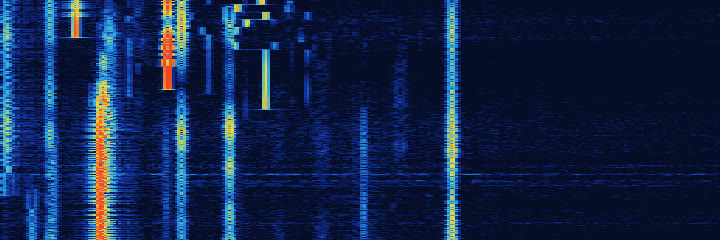
12-second example. Recording: Freesound recording freesound-psk31-multiple-14071khz-usb-242994 (CC0).
Who uses it?
Amateur radio operators.
Where and when can I hear it?
Around 14.070 MHz and similar spots on other ham bands.
What do the decoded parts mean?
- Text: Typed conversation, usually starting with CQ and call signs, often with the operator's name, location and equipment.
Easily confused with
- Morse code (CW): Morse switches fully off between elements
- PSK63 / PSK125: PSK63 is twice as fast and twice as wide
How to recognize it
PSK31 uses a single tone and sends data by flipping its phase 31.25 times per second. Each flip briefly dips the volume, so the ear hears a smooth, fluttering warble rather than separate notes. When a station is idle between words, it sends continuous phase flips, which on a waterfall look like two thin parallel lines, sometimes called railroad tracks.
The signal is tiny, only about 60 Hz wide, so a 3 kHz slice of band can hold dozens of conversations. Clean signals look like neat narrow stripes; an overdriven transmitter shows extra stripes on either side.
Easily confused with:
- PSK63 and PSK125: the same idea, faster and wider, with a quicker flutter.
- RTTY: two distinct alternating tones, harsher and wider.
- FT8: similar softness, but everything starts and stops together on a 15-second clock.
Where and when to hear it
The best-known spot is 14.070 MHz (upper sideband) on 20 meters, with activity in the first couple of kilohertz above it. Other common spots include 3.580, 7.070 (in the Americas), 10.142, 18.100, 21.070 and 28.120 MHz. Activity has fallen since FT8 arrived, so weekends and evenings are the best times.
For a signal with known text, W1AW sends ARRL bulletins in PSK31 on a rotating schedule, on frequencies including 7.095 and 14.095 MHz.
A typical PSK31 contact is relaxed and chatty: a CQ call, then an exchange of names, locations, equipment and weather, typed live at roughly the speed people type. Because signals are so narrow, it rewards careful tuning; a signal a few hertz off center decodes poorly or not at all.
A little history
Peter Martinez, G3PLX, developed PSK31 in the late 1990s, building on earlier phase-shift experiments by Polish amateur Pawel Jalocha, SP9VRC. Martinez designed it for live, typed conversation at about typing speed, using the sound cards that had just become common in home computers.
A clever part of the design is its alphabet, called Varicode: common letters get short codes and rare ones long codes, much like Morse code. Lowercase letters are the most common, so they are sent faster than capitals. PSK31 quickly became the most popular keyboard mode on HF and held that place until the rise of FT8.
Common questions
Is it legal to listen to PSK31?
Yes. PSK31 is an open amateur mode, and anyone may receive it.
Why does PSK31 sound like a warble instead of beeps?
It does not switch between tones. It keeps one tone and flips its phase, and each flip briefly softens the sound, producing a regular flutter at the 31.25-per-second rate.
Why are lowercase letters faster in PSK31?
Its Varicode alphabet gives the shortest codes to the most frequent characters, and lowercase letters appear far more often than capitals in normal text.
How do I decode PSK31?
Free programs such as fldigi decode PSK31. Tune in upper sideband and click on a signal in the waterfall; many programs can decode several signals at once.