Radioteletype (RTTY)
Text sent by switching quickly between two tones. One of the oldest data modes, still used for ham contests and some weather and news services.
RTTY sounds like a fast, even two-note warble, the tones flipping back and forth so quickly they blur into a steady 'diddle' that runs without pauses while text is sent.
What does it sound like?
A fast, two-note warble or 'diddle', like a rapid bird call.
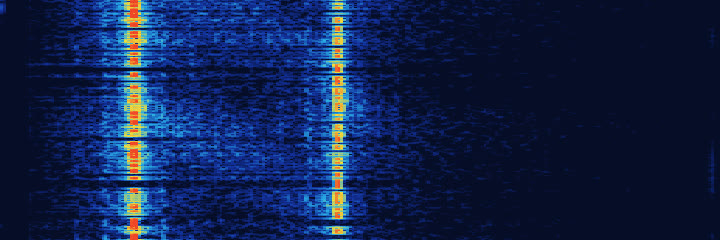
4.5-second example. Recording: Freesound recording freesound-hf-sound-003-rtty-850hz-shift-digital-transmission-752465 (CC0).
Who uses it?
Amateur radio contesters and operators, and utility stations such as weather services (for example, Germany's weather service sends RTTY forecasts).
Where and when can I hear it?
Ham RTTY is common around 14.080-14.100 MHz and similar spots on other bands, especially during contest weekends.
What do the decoded parts mean?
- Text: Plain text, usually in capital letters. In contests you'll hear repeated exchanges such as call signs, signal reports (599) and location or serial numbers.
- Speed and shift: Speed in baud (45.45 is standard for hams; 50 and 75 are common elsewhere) and the spacing between the two tones in Hz (170 Hz for hams, 425 or 850 Hz for some utility stations).
Easily confused with
- NAVTEX (maritime safety text): NAVTEX is on 518 kHz, in scheduled bursts
- Pager signal (POCSAG): pager data comes in short bursts with a long preamble
- Digital Selective Calling (DSC): DSC sends short bursts on marine calling channels
How to recognize it
RTTY (radioteletype) sends each character by switching between two fixed tones, called mark and space. On the ham bands the tones are 170 Hz apart and switch at 45.45 baud, which gives about 60 words per minute. On a waterfall you see two parallel lines close together.
Even when no letters are being typed, a transmitting station keeps up a steady idle pattern, so RTTY rarely has the gaps you hear in Morse. Commercial and weather services often use 50 or 75 baud and a wider 450 Hz shift, which sounds brighter and quicker.
Easily confused with:
- NAVTEX and SITOR: also two tones 170 Hz apart, but at 100 baud, faster and choppier.
- PSK31: one soft tone rather than two distinct notes.
- Weather fax: a rhythmic scraping at two strokes a second, not a constant chatter.
Where and when to hear it
Ham RTTY is found around 14.080-14.100 MHz, 7.040-7.050 MHz (varies by region) and 3.580-3.600 MHz. It comes alive during RTTY contests, when stations fill whole band segments; two of the biggest are the ARRL RTTY Roundup in early January and the CQ World Wide RTTY DX Contest in late September.
For a known signal, W1AW sends ARRL bulletins in 45.45-baud RTTY on a rotating schedule alongside PSK31 and MFSK16, on frequencies including 7.095 and 14.095 MHz. Outside the ham bands, Germany's weather service (Deutscher Wetterdienst) broadcasts marine weather in RTTY, including around the clock on 10100.8 kHz with a 450 Hz shift.
A little history
RTTY grew out of the teleprinter, the electromechanical typewriter-on-a-wire that carried news and business messages from the 1920s on. Militaries and news agencies moved teleprinter traffic onto radio, and after World War II radio amateurs adapted surplus Teletype machines to do the same. Early ham stations clattered with heavy mechanical printers; today a sound card and free software do the work.
Ham RTTY still uses the five-bit Baudot (ITA2) alphabet, which has only capital letters and switches between a "letters" set and a "figures" set. That is why RTTY text arrives in capitals, and why a missed shift character can briefly turn words into strings of numbers and punctuation.
Common questions
Is it legal to listen to RTTY?
Yes. Amateur RTTY and public weather broadcasts are open transmissions with published formats, and anyone may receive them.
Why does RTTY text sometimes turn into numbers and symbols?
RTTY's alphabet uses a shift code to switch between letters and figures. If noise corrupts that code, the decoder prints the wrong set until the next shift arrives. Many programs offer an "unshift on space" option to limit the damage.
What do 45.45 baud and 170 Hz shift mean?
Baud is the number of tone changes per second, so it sets the speed. Shift is how far apart the two tones are. Hams use 45.45 baud and 170 Hz; commercial services often use 50 baud and 450 Hz or other combinations.
How do I decode RTTY?
Free programs such as fldigi and MMTTY decode RTTY from a receiver's audio. Tune in upper or lower sideband so the two tones fall in the program's markers, and choose the correct speed and shift.