Weather fax (radiofax)
Weather maps and charts sent as sound, one line at a time, mainly for ships.
Weather fax sounds like a steady, rhythmic scraping or swishing, about two strokes per second, that goes on for ten minutes or more while a chart is sent line by line.
What does it sound like?
A steady, rhythmic scraping or 'swishing', about two strokes per second, starting with distinct start tones.
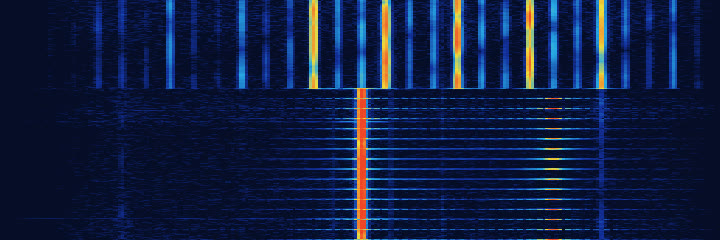
12-second example. Recorded off the air on the developer's own receiver.
Who uses it?
National weather services and coast guards; received by sailors and hobbyists.
Where and when can I hear it?
Shortwave, on published schedules. In the US, NOAA charts are sent from Point Reyes, California (for example 8682 and 12786 kHz) and from other coast stations.
What do the decoded parts mean?
- Chart: The image: surface analysis, forecasts, wave heights, satellite pictures and more, as listed in the station's schedule.
Easily confused with
- Slow-scan TV (SSTV): SSTV warbles in pitch and finishes a picture in minutes
- Weather satellite pictures (APT): APT came from satellites at 137 MHz
How to recognize it
Radiofax sends a picture one line at a time as a tone that moves between about 1500 Hz for black and 2300 Hz for white. Most stations send 120 lines per minute, two lines per second, which produces the regular "swish-swish" rhythm. Dense text and coastlines make the sound rougher; empty white areas sound like a smooth steady tone.
A transmission begins with a start tone of a few seconds, then about half a minute of phasing signal (short regular clicks that line up the picture), then the image, and ends with a stop tone.
Easily confused with:
- SSTV: pictures too, but with a musical header and a sweeping, faster sound, lasting only one to two minutes.
- NOAA weather satellites (APT): the same two lines per second, but heard only during satellite passes on 137 MHz.
- RTTY: a constant two-tone chatter with no line rhythm.
Where and when to hear it
In the United States, the Coast Guard broadcasts National Weather Service charts from Point Reyes, California (NMC, including 4346, 8682, 12786, 17151.2 and 22527 kHz), Boston (NMF), New Orleans (NMG), Kodiak (NOJ) and Honolulu (KVM70). Many other countries run their own, such as Germany's DDH/DDK and Japan's JMH.
Radiofax frequencies are published as the assigned frequency; tune your receiver in upper sideband 1.9 kHz lower so the tones fall in the right place. Exact times for each chart are listed in NOAA's worldwide radiofax schedule.
Because charts follow a fixed timetable, radiofax is one of the most predictable signals on shortwave: look up the next surface analysis or wave forecast, tune in a minute early, and listen for the start tone. Nighttime favors the lower frequencies and daytime the higher ones, so stations send on several at once.
A little history
Sending pictures over wires dates to the mid-1800s, when Alexander Bain patented an early facsimile idea in 1843. Radio facsimile developed in the 1920s and 1930s, first for news photos and then for weather maps sent to ships and airfields. For decades, ships carried dedicated fax recorders that burned or printed charts onto paper.
Radiofax remains in service because it needs nothing but a shortwave receiver, works far from any internet connection, and covers whole oceans, which is why offshore sailors still use it.
Common questions
Is it legal to receive weather fax?
Yes. These are public weather broadcasts sent for anyone at sea, and receiving them is lawful. For safety decisions, rely on official, current forecasts through proper marine equipment.
Why does weather fax go on for so long?
At two lines per second, a detailed chart of about a thousand lines or more takes around ten minutes, sometimes longer.
Why is my weather fax picture slanted or offset?
A slant means the decoding program's timing differs slightly from the transmitter's; an offset means it missed the phasing signal. Most programs let you correct both.
How do I decode weather fax?
Free programs such as fldigi (WEFAX mode) and HamFax can decode it from a shortwave receiver's audio in upper sideband.